Underground water leak detection in Scotland
Underground water leak detection finds a leak on the buried supply pipe between the stopcock and the property, the length of pipe the owner, not Scottish Water, is responsible for.

Illustration: a supply pipe leak under the front garden, between the stopcock and the house.
Who is responsible for an underground water leak in Scotland?
Scottish Water is responsible for an underground leak up to and including the stopcock, and the property owner is responsible for a leak from the stopcock to the property. The stopcock is Scottish Water's valve on the supply, usually near the property boundary and sometimes just inside it.
Scottish Water maintains the public water main, the communication pipe that joins it to the stopcock, the stopcock itself and any water meter. The owner maintains the supply pipe (the buried pipe from the stopcock to the internal stop valve inside the home) and every pipe after it, even where that supply pipe runs beyond the boundary.
Where several homes share one supply pipe, the owners on it may be jointly liable for a leak. In a tenement the title deeds split the cost, or the Tenement Management Scheme does where the deeds are silent. A tenant tells the landlord, and the landlord arranges the repair.
A leak on the public main or at the stopcock is Scottish Water's to put right, and it takes reports online or on 0800 0778 778, 24 hours a day.
How can you tell if there is a water leak underground?
Ground that stays wet or soft in dry weather along the line of the supply pipe can mean water is leaking underground, although most supply pipe leaks show nothing at the surface at all.
- Ground that stays wet or soft in dry weather is worth reporting when the rest of the garden has dried out, Scottish Water says.
- Greener or faster-growing grass can grow over water escaping from the pipe below.
- Lower water pressure at the taps can mean water is leaking out before it reaches the house.
- A hiss at the internal stop valve with every tap and appliance off can mean a leak.
- Hissing that continues after the stop valve is shut points to a leak outside the property.
- A meter dial that keeps moving with no water in use most likely shows a leak on metered premises, where the meter sits beside the stopcock.
How is an underground water leak found?
An underground water leak is found by pressure testing the supply pipe, following its route between the stopcock and the house, and pinpointing the leak with acoustic ground microphones or with tracer gas that rises through the ground.
- Pressure testing
- A system or a section of it is sealed, pressurised and watched on a gauge over a set time, and a part that will not hold its pressure normally has a leak.
- Suits Proving the supply pipe is losing water before any ground is dug, with the run between the stopcock and the internal stop valve sealed and watched on a gauge.
- Acoustic listening
- A listening stick on a pipe or fitting, or a ground microphone on the surface, picks up the noise of water escaping from a pressurised pipe, and the leak lies near the point where the sound is loudest.
- Suits A supply pipe under mains pressure, listened to at the stopcock and the internal stop valve and then along the ground above its route, under lawns, paths and drives.
- Tracer gas
- The pipe is drained and filled with a mix of 5% hydrogen and 95% nitrogen, which escapes at the leak and rises through the floor or ground, where a hydrogen detector finds the highest reading.
- Suits A supply pipe whose leak is too quiet to hear, or a plastic pipe, with the gas rising through concrete, tarmac, block paving or grass to the detector.
Acoustic listening suits a supply pipe because a pressurised pipe that is leaking makes a noise, and Scottish Water says its own equipment can hear escaping water when the householder can see and hear nothing. It needs that noise: where the leak is silent, tracer gas is used instead, and how long the gas takes to reach the surface depends on the ground it rises through.
What happens once an underground leak is found?
Once an underground leak is found, the spot is marked on the surface so the excavation is short, and the next call is to Scottish Water to ask whether its assisted repair applies before any repair is booked.
Marking the supply pipe leak on the ground
The leak position is marked on the lawn, path or drive, so the dig to reach the supply pipe is kept as short as possible.
Asking Scottish Water about an assisted repair
Scottish Water decides case by case whether its discretionary assisted repair or replacement applies to a domestic supply pipe, so it is worth asking before arranging anything.
Booking the repair with the findings
The findings give the leak's location, the access work needed and photographs, for the plumber, the neighbours on a shared pipe or the insurer.
Which other leaks does Caledonian Leak Detection find?
Inside the property, Caledonian Leak Detection finds hidden pipe leaks and central heating leaks too, anywhere in mainland Scotland.
Hidden pipe leaks
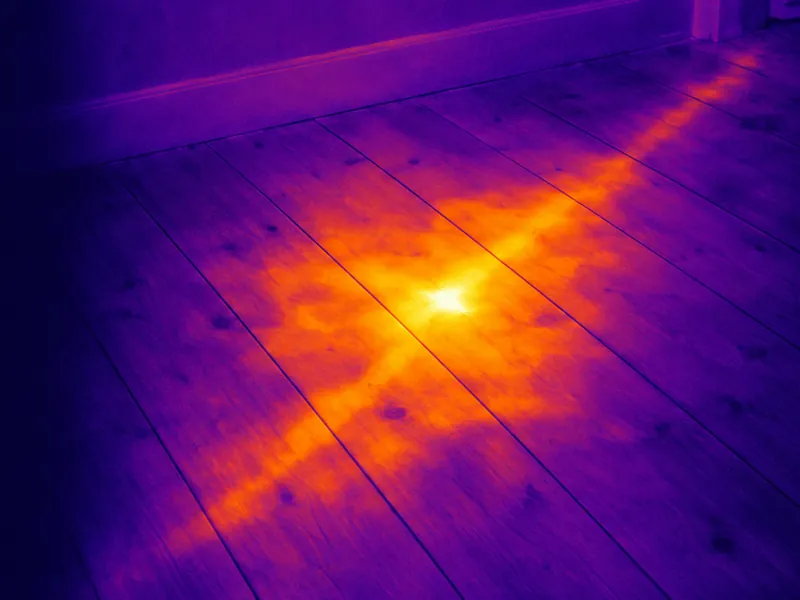
When the noise stops as the stop valve closes, the leak is probably indoors: read about hidden leak detection for water pipes.
Central heating leaks

A boiler gauge that keeps dropping points to the heating instead, and to central heating leak detection.
The Glasgow, Edinburgh, Aberdeen and Dundee pages sit with the overview of leak detection in Scotland.