Central heating leak detection in Scotland
Central heating leak detection finds where water is escaping from a heating system, the usual reason a boiler keeps losing pressure, by testing the circuit and tracing its pipe runs before floors are lifted.

Illustration: a heating pipe leak spreading under the floor beside a radiator.
Why does a boiler keep losing pressure?
A boiler keeps losing pressure because water is escaping from the sealed heating circuit, and a leak on the pipework is the most common cause.
A sealed system should hold its pressure, so a gauge that falls again and again between top-ups has lost water somewhere.
The causes the boiler makers point to, starting with the most common, are:
- a leak at a radiator valve or a joint you can see, which is the first place to look;
- a hidden leak on pipework under the floor, behind boxing or in an underfloor heating loop;
- a faulty pressure relief valve, which can show as a dripping pipe on the outside wall where it discharges;
- a leak inside the boiler itself.
Bleeding radiators lets a little water out too, so it can account for a small drop just after bleeding. Valves and the boiler are a job for a heating engineer; never take the boiler casing off yourself.
Why does topping up the boiler not fix a central heating leak?
Topping up refills the circuit but leaves the leak where it is, so the water you add escapes by the same route and the needle falls again. It is worth keeping a note of each top-up: Ideal treats once or twice a year as normal and once a month or more as a sign of a small leak or a faulty pressure relief valve.
What are the signs of a central heating leak?
The plainest sign of a central heating leak is a boiler pressure gauge that falls between top-ups, and these other signs usually show near the pipework that carries the heating water.
- Pressure that falls between top-ups with no radiator bled usually means water is leaving the circuit through a leak.
- Damp spots or rust marks around radiators can show a leak at a radiator valve, the most common place for one.
- Bubbling skirting boards or flaking wallpaper can mark damp along a boxed-in heating pipe.
- Water stains or warped boards on a floor can sit over a leaking radiator pipe or underfloor heating loop.
- A stain on the ceiling below can come from heating pipework leaking in the floor above.
- A dripping discharge pipe outside can mean the pressure relief valve is faulty.
How is a central heating leak found?
A central heating leak is found by pressure testing the circuit, then tracing its pipe runs with a thermal imaging camera while the heating runs, and confirming the spot with tracer gas where the heat picture is not clear.
- Pressure testing
- A system or a section of it is sealed, pressurised and watched on a gauge over a set time, and a part that will not hold its pressure normally has a leak.
- Suits A sealed heating circuit, which the boiler gauge already reads as one system, and underfloor heating, where each loop is tested on its own until the one that will not hold is found.
- Thermal imaging
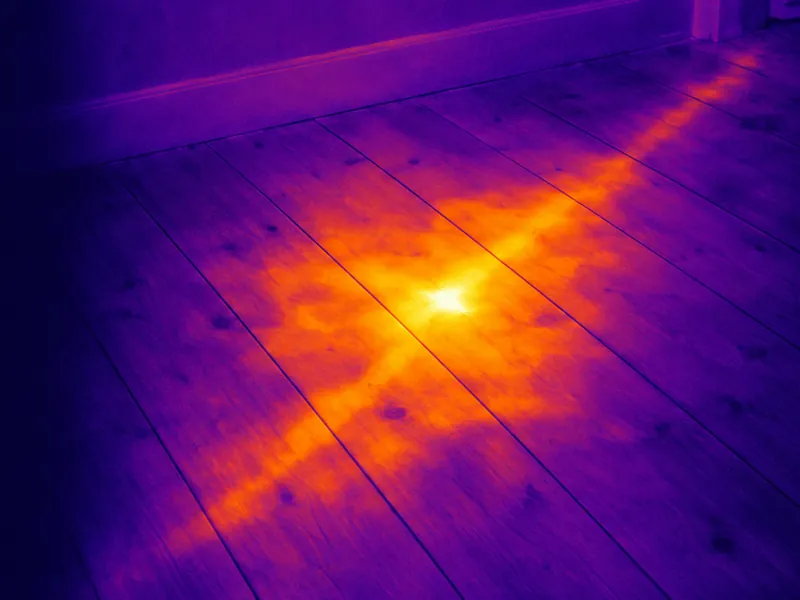
- A thermal imaging camera shows the temperature of the surface it is pointed at, so water escaping from a hot pipe, central heating or underfloor heating shows as a warm patch, and damp can show as a cool one.
- Suits Radiator pipes under floorboards and underfloor heating in concrete or tiled floors, scanned while the heating runs so the leak shows as an irregular hot spot.
- Tracer gas
- The pipe is drained and filled with a mix of 5% hydrogen and 95% nitrogen, which escapes at the leak and rises through the floor or ground, where a hydrogen detector finds the highest reading.
- Suits Heating pipes where the leak is too small or too quiet to find another way, including underfloor heating loops.
How is an underfloor heating leak traced?
An underfloor heating leak is traced with a thermal imaging camera while warm water runs through the loops, because the escaping water spreads heat into the floor around the leak. Grant UK notes that where an underfloor system loses pressure with no visible sign, each loop may need its own pressure test to find the one that leaks. A thermal camera only reads the surface, so a hot spot is checked before anything is cut. Acoustic listening can help on a pressurised run where the leak is loud enough to hear.
Does a leak sealer find a central heating leak?
No. A leak sealer added to the heating water does not locate anything, so the position of the leak stays unknown whether or not the sealer slows it.
Before anything goes into a sealed system, check the boiler's manual or ask a heating engineer, because the maker's instructions for that boiler come first. If the pressure keeps falling, the leak is still there and still putting water into the floor or wall around it.
What happens once a central heating leak is found?
A central heating leak, once found, gets its position marked for the repair, and the findings support an insurance claim where the policy includes trace and access cover.
Marking the spot lets the heating engineer or plumber keep the opening in the floor or wall small. The written findings name the part of the circuit that leaks, where it sits, the access it needs and photographs of it. Caledonian Leak Detection finds the leak; the repair itself, and any work on the boiler, is for a heating engineer.
Which other leaks does Caledonian Leak Detection find?
Caledonian Leak Detection also finds hidden leaks on the hot and cold water pipes indoors, and underground leaks on the supply pipe outside.
Hidden pipe leaks
Damp from a tap or shower supply rather than the heating calls for hidden leak detection for water pipes.
Underground supply pipe leaks
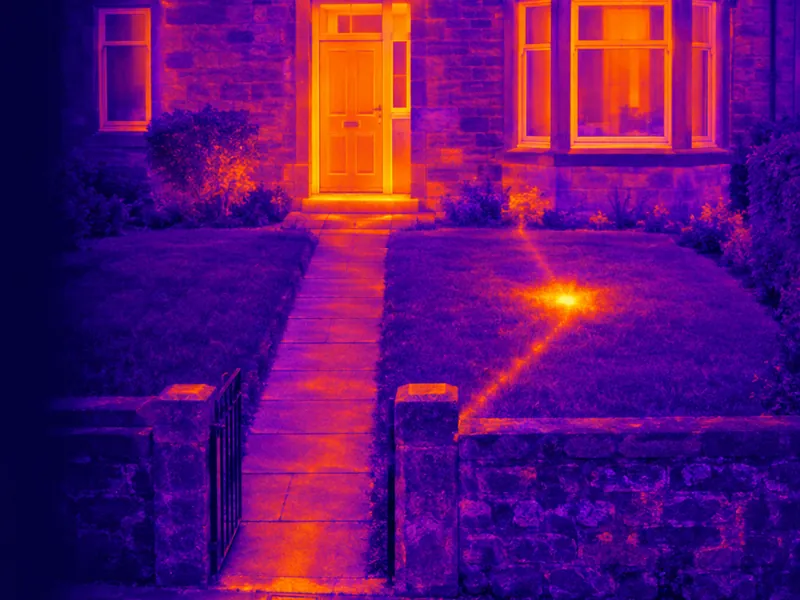
Falling pressure at the taps or wet ground outside calls for underground water leak detection on the supply pipe.
The pages for Glasgow, Edinburgh, Aberdeen and Dundee are all reached through leak detection in Scotland.